
Quick Answer: The 2026 Reality for Nifty Option Buyers
In Nifty 50 option buying, most retail traders lose because they chase obvious breakouts and buy random Call/Put options near highs and lows. In 2026, the edge is in "Operator Trap Trading" — waiting for fake breakouts, understanding Open Interest (OI) shifts, and entering after stop-loss hunting is complete, not before it starts.
You buy a Nifty Call because price breaks the Day High. The move looks powerful, social media is bullish, and your broker app shows green candles everywhere.
Within 5–10 minutes, a big red candle crashes the market, hits your Stop Loss, and then the index falls another 80–100 points without you. You sit there thinking, "Did the market just trap me on purpose?"
It did not target you personally — but it did target your behaviour.
In the Indian derivatives market, you are not fighting just other retail traders. You are trading against:
- FIIs & DIIs who move thousands of lots at a time.
- High-speed algorithms that detect trapped traders within seconds.
- Professional option writers who collect Theta every single day.
At Trade Like Master, we teach one core principle to our option buyers:
"If the move looks too easy, it is usually a trap set for you."
Educational Disclaimer
This article is for education only. Trading Nifty, BankNifty or any derivatives involves significant risk. Do not risk money you cannot afford to lose. Always consult your financial advisor and test any strategy in paper trading or with very small size first.
The Nifty Option Buying Masterclass (2026 Edition)
- 1. The Operator Mindset: Who Actually Moves Nifty?
- 2. The "9:15 AM Trap" Strategy (Fake Breakout Logic)
- 3. Decoding Open Interest (OI) & Option Chain Data
- 4. The Silent Killer: Theta, Gamma & Why ITM is King
- 5. Risk & Money Management for Option Buyers
- 6. Intraday Checklist: One Page Before You Trade
- 7. Grand Slam Offer: Trade Live Operator Traps With Us
- 8. Frequently Asked Questions
1. The Operator Mindset: Who Actually Moves Nifty?
Retail traders think in points and P&L. Operators think in liquidity and inventory.
When FIIs/DIIs want to build a large Nifty futures or options position, they cannot simply press the Buy button. If they do, price will spike instantly and their average entry will be terrible.
So they use a different approach:
- Create a pattern retail traders recognise (breakout, head-and-shoulders, double-top).
- Trigger emotions — fear and greed — near those levels.
- Generate liquidity by forcing retail Stop Losses to trigger.
- Absorb orders at discounts when retail is trapped.
Operator Playbook in Simple Words
1. Show a bullish pattern -> Retail buys Calls. 2. Crash price suddenly -> Hit their Stop Loss. 3. Absorb their panic selling -> Build long positions. 4. Reverse price -> Move towards their original target.
Once you understand this, you stop asking, "Why is the market against me?" and start asking, "Who is being trapped here and how can I avoid joining them?"
2. The "9:15 AM Trap" Strategy (Fake Breakout Logic)
The first 15 minutes of the Indian market (9:15–9:30 AM) are dominated by overnight orders, gap opens, and aggressive algorithmic moves.
For retail option buyers, this is the most dangerous time to chase breakouts and the best time to hunt traps.
Step 1: Mark the Previous Day High & Low (PDH / PDL)
Before market opens, mark:
- Previous Day High (PDH) – main liquidity zone for Call buyers and Short Sellers’ stops.
- Previous Day Low (PDL) – main liquidity zone for Put buyers and Long holders’ stops.
Step 2: Observe the First 15 Minutes – No Trading Rule
From 9:15 to 9:30 AM:
- Do not trade. Only observe.
- Note if Nifty is rushing quickly towards PDH or PDL.
- Let the opening volatility settle. You are a sniper, not a machine gun operator.
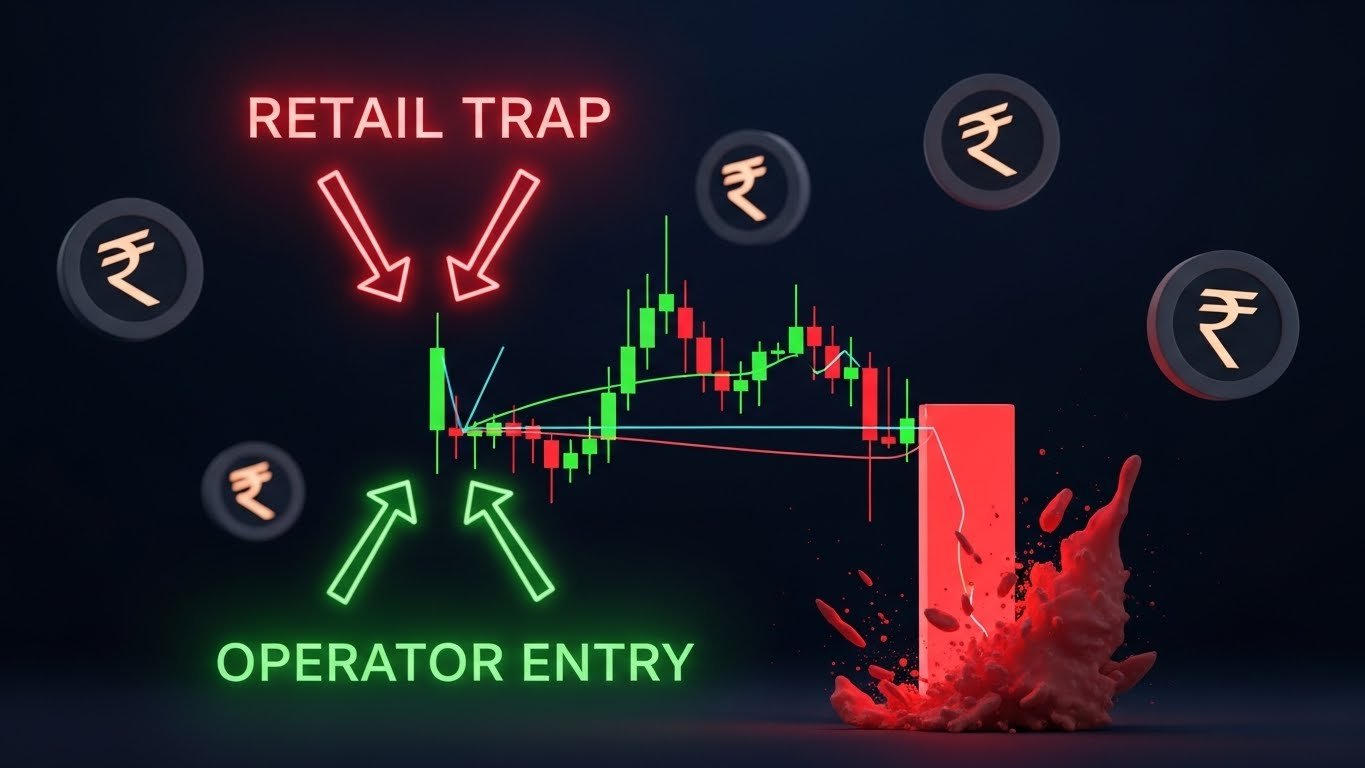
Step 3: The Fake Breakout (Trap Candle)
For a bearish trap (PE buying) at PDH:
- A strong green candle breaks above PDH with excitement.
- Call buyers jump in, thinking this is a clean breakout.
- The next candle is a sharp red candle closing back below PDH, leaving a long wick above.
This is your Trap Candle. It tells you the Operator used the breakout to fill sell orders and is now reversing the market.
Step 4: Entry, Stop Loss & Target Plan
- Entry: Buy an ITM Put Option (PE) once the red candle closes back inside the range (below PDH).
- Stop Loss: Above the wick of the Trap Candle (above the fake breakout high).
- First Target: Day’s Open or a nearby intraday support.
- Extended Target: PDL, if momentum and OI data supports a deeper move.
Pro Tip: Time Filter
Avoid buying breakouts or breakdowns in Nifty before 10:15 AM. Let the first wave of traps complete. The cleanest moves often start after the opening noise is absorbed.
3. Decoding Open Interest (OI) & Option Chain Data
Price action shows you what is happening. Open Interest (OI) shows you who is participating in the move.
Combine both, and you start seeing whether the breakout is real or manipulated.
Futures OI: The Four Core Scenarios
| Scenario | Price Action | OI Behaviour | Interpretation |
|---|---|---|---|
| Long Build-Up | Price Up | OI Up | Fresh Long positions. Trend is strong. Buying Calls is aligned with big players. |
| Short Build-Up | Price Down | OI Up | Fresh Short positions. Buying Puts is aligned with big players. |
| Short Covering | Price Up | OI Down | Shorts are exiting. Upmove may be temporary. Avoid chasing late Calls. |
| Long Unwinding | Price Down | OI Down | Longs are exiting. Downmove may be temporary. Avoid panic selling. |
Option Chain: Reading Call/Put Writers
Option writers are often the professionals. When they refuse to exit, it usually means the breakout will fail.
- Call OI at resistance: If price breaks above a level but Call OI at that strike is not reducing, Call writers are still confident. Breakout is likely to be a trap.
- Put OI at support: If price breaks below a support but Put writers are not exiting, breakdown is likely to fail.
- Watch for sudden OI shift (heavy unwinding + build-up at next strike) – this often confirms where the next move is headed.
Secret Tip: OI + Price Divergence
If Nifty is moving up but Call OI is steadily increasing at nearby strikes, it is often a short-covering + fresh writing trap, not a clean uptrend. In these zones, it is usually better to wait for a reversal opportunity instead of chasing Calls.
4. The Silent Killer: Theta, Gamma & Why ITM is King
Most retail option buyers think only in terms of direction: "Nifty will go up, so I buy a Call."
But options are not linear products. They are affected by time (Theta), speed (Gamma), volatility (Vega) and direction (Delta).
Why ITM Options for Intraday Buying?
- Higher Delta: ITM options (1–2 strikes inside) have Delta of ~0.6–0.8. If Nifty moves 50 points, your premium can move 30–40 points.
- Slower Theta Decay: ITM premiums decay slower than cheap, lottery-style OTM options.
- Better Risk/Reward: You pay more per lot, but your probability of profitable movement is higher and more stable.
Simple Rule for 2026: If Nifty is at 24,000:
- For bullish traps, consider buying 23,900 CE or 23,850 CE (ITM).
- For bearish traps, consider buying 24,100 PE or 24,150 PE (ITM).
Gamma: The Expiry Day Weapon
On weekly and monthly expiry days, Gamma is extremely high. Small moves in Nifty can cause very aggressive moves in option premiums.
- A 30–40 point move in Nifty can double or halve an At-the-Money (ATM) option in minutes.
- Great for experienced scalpers; extremely dangerous for traders without risk control.
Avoid OTM Lottery Tickets
Cheap OTM options look attractive because of low price, but they are usually designed for option writers to earn Theta. If your goal is consistent intraday income, focus on ITM or ATM options with a clear trap-based entry, not random OTM gambling.
5. Risk & Money Management for Option Buyers
Even the best Nifty option strategy fails without disciplined risk management. Professionals think in terms of risk per trade, daily loss limits and weekly drawdowns.
Position Sizing for Nifty Option Buyers
- Risk 0.5%–1% of your capital on a single trade. For example, with ₹2,00,000 capital, risk per trade should be ₹1,000–₹2,000.
- Calculate lot size based on Stop Loss distance in premium, not random fixed lot count.
- New traders should start with the minimum lot size and focus on process, not profit.
Daily & Weekly Loss Limits
- Daily Max Loss: 3% of capital. After this, stop trading for the day.
- Weekly Max Loss: 6–8%. If you hit this, cut your size or take a break to review trades.
- Maintain a trade journal with screenshots, reasons for entry/exit, and emotions felt.
Pro Tip: Protecting Capital = Protecting Opportunity
Your biggest edge is staying in the game long enough to let a good system play out. Capital protection is not conservative – it is professional.
6. Intraday Checklist: One Page Before You Trade
Before entering any Nifty option trade, run through this checklist:
- Have I marked PDH/PDL and important swing highs/lows?
- Is this move a clean trend or a potential trap around a key level?
- Does Futures OI confirm Long/Short build-up in my direction?
- Does Option Chain show writers getting uncomfortable or still confident?
- Is my risk per trade within my daily limit?
- Is this an ITM/ATM option or a random far OTM?
- Do I have a clear Exit Plan (SL, Target, Trailing Rules)?
7. Grand Slam Offer: Trade Live Operator Traps With Us
Stop Guessing. Start Trading With Live Guidance.
Reading about Operator Traps is one thing. Seeing them unfold live on Nifty and BankNifty, with real-time explanation, is a different experience. Inside our Live Trading Room, we analyse OI, price action, and traps as they form — not after the move is over.
Join Our Nifty & BankNifty Live Trading Room
- Real-time trap identification near PDH/PDL, gap zones and key levels.
- Live commentary on OI shifts, option chain changes and institutional behaviour.
- Risk management alerts, partial booking guidance, and emotional control tips.
Join Live Session Now
*First 50 members receive lifetime access to our custom "Trap Indicator" template for TradingView.
8. Frequently Asked Questions
Is option buying better than selling for small traders?
For capital below approximately ₹5–₹10 Lakhs, option buying often provides better percentage returns, provided you use ITM/ATM options, trap-based entries and strict risk control. Option selling is powerful for income but usually suits traders with larger capital and strong risk discipline.
Which timeframe is best for Nifty option buying entries?
A practical framework is: 15-Minute timeframe for key levels and bias, 5-Minute or 3-Minute timeframe for entry confirmation around traps, and, if needed, 1-Minute for very precise scalps once you are experienced.
How do I identify a false breakout in real-time?
A breakout is suspicious when: 1) It happens directly at market open, 2) Volume is not supporting the move, 3) Option writers (Call or Put OI) are not exiting in the option chain, and 4) The follow-through candles fail to hold above/below the breakout level and quickly reverse back inside the range.
Should I trade Nifty or BankNifty for this trap strategy?
The same trap logic works on both Nifty and BankNifty. Nifty is generally smoother with slightly lower volatility, making it better for beginners. BankNifty offers larger intraday ranges and faster moves, which can be rewarding but also more stressful without experience.
How many trades should I take in a day using this approach?
You do not need 10–15 trades per day. Often, 1–3 high-quality trap-based trades are enough. Over-trading usually comes from boredom or revenge trading and often leads to breaking your risk rules.
Can this strategy guarantee profit if followed strictly?
No strategy in the market can offer guarantees. The Operator Trap framework is a probability-based approach, not a magic formula. Your results will depend on discipline, execution consistency, risk management, market conditions and your emotional control.
Is this suitable for working professionals who cannot watch markets all day?
Yes, if you focus on specific time windows like 9:30–11:00 AM and avoid trading full-day noise. Many working traders choose to focus on just 1–2 high-probability zones (like the 9:15 AM trap and post-lunch reversals) instead of staring at screens the entire day.
Can your Live Trading Room trade on my behalf?
No. We do not provide portfolio management, PMS or guaranteed returns. Our Live Trading Room and programs are strictly educational. You are always responsible for your own trades, risk, and capital decisions.

Written by Trade Like Master
Trade Like Master is a team of experienced derivatives traders and mentors specialising in Nifty, BankNifty and index options. We focus on institutional-style analysis, trap-based trading and rule-driven risk management to help traders move beyond random breakout gambling.