

Quick Answer: The 2026 Strategy
In 2026, standard Support & Resistance levels on Gold (XAUUSD) are primarily used by algorithms as liquidity traps. The winning 1-minute scalping strategy involves waiting for a Liquidity Sweep (price breaking a previous high/low to trap traders) followed by a Displacement (aggressive reversal). Traders should enter on the retest of the Fair Value Gap created by this reversal, targeting the opposing liquidity pool.
You draw a perfect resistance line at 2050. You wait patiently. The price touches it. You sell.
It works for 5 minutes. You are in profit.
Then, suddenly, a massive Green Candle shoots up, smashes your Stop Loss by 2 pips, and then immediately crashes down 100 pips in the direction you predicted.
Sound familiar?
That was not bad luck. That was not a "glitch." That was an Institutional Stop Hunt.
Welcome to trading Gold in 2026. The market has changed. With the dominance of AI-driven High-Frequency Trading (HFT) algorithms, traditional retail patterns like "Double Tops" and "Trendlines" have become traps. If you want to survive as a scalper today, you cannot trade like it's 2015.
In this comprehensive guide, I will deconstruct the exact 1-Minute Scalping Strategy we use at Trade Like Master to catch these institutional moves. We don't predict the market; we let the banks show us their hand first.
📋 Table of Contents
1. The Institutional Logic: Why You Keep Losing
To understand how to win, you must understand how the "Smart Money" (Banks, Hedge Funds, Algorithms) operates. They have a problem that you don't have: Size.
If JP Morgan wants to Buy $500 Million worth of Gold, they cannot just click "Buy." If they did, the price would skyrocket instantly, and they would get a terrible entry price (slippage).
They need someone to sell to them. They need Liquidity.
Where is the Liquidity?
It is where Retail Traders place their Stop Losses.
- Above Old Highs: Sellers have their Stop Losses here (Buy Stops).
- Below Old Lows: Buyers have their Stop Losses here (Sell Stops).
The algorithm's job is to push the price through these levels to trigger your stops. Once your stop is hit, your order executes. This provides the liquidity the bank needs to enter their massive position in the opposite direction.
The Hard Truth
Your Stop Loss is not protection for the bank. It is fuel. The "Liquidity Sweep" strategy is simply waiting for the bank to fuel up before we jump in the car with them.
2. The Setup: Anatomy of a Liquidity Sweep
Forget the 4-hour chart. If you are scalping, we are going into the trenches of the 1-minute timeframe. However, context is key.
The 3 Phases of the Trade
Phase 1: The Inducement (The Trap)
The market creates a clean "Support" or "Resistance" level. It touches it 2 or 3 times. Retail traders see this and think "Wow, strong support!" and they place their Buy Limit orders there with stops just below.
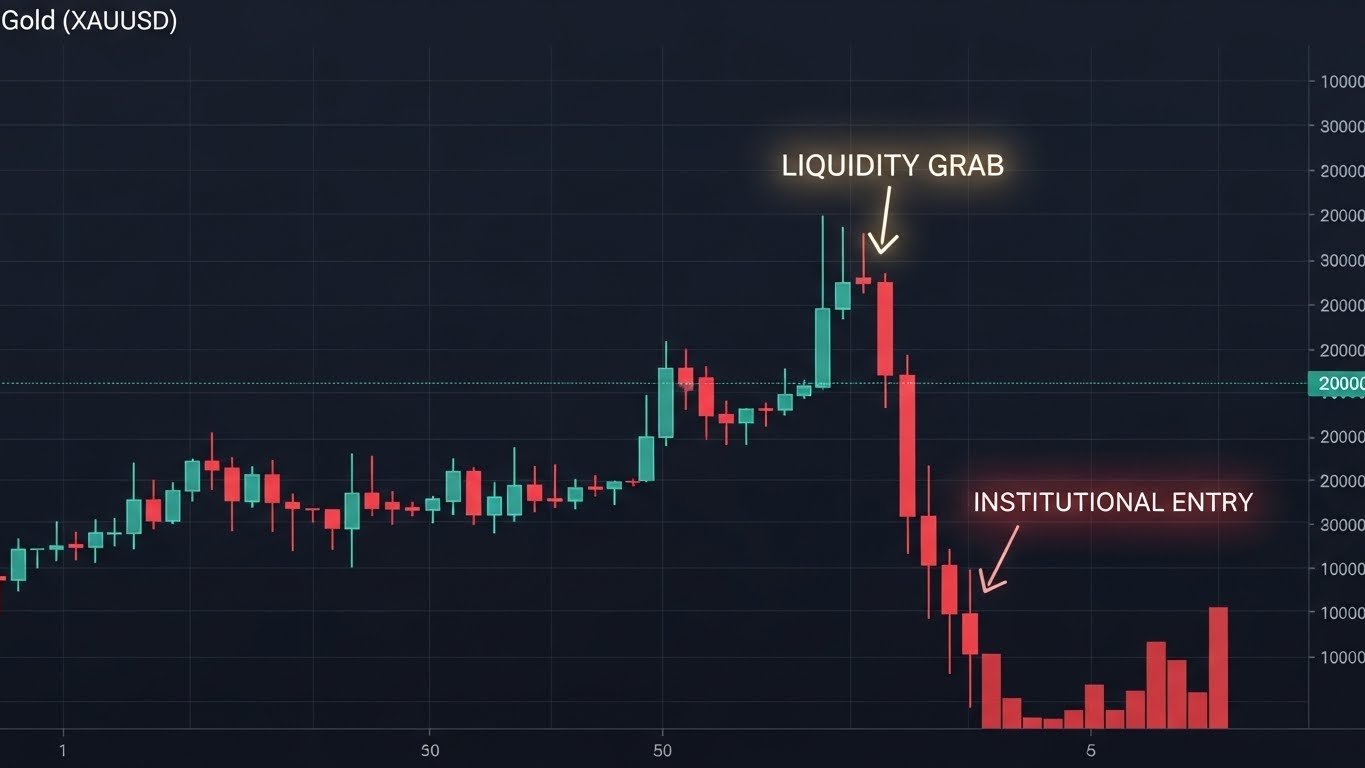
Phase 2: The Sweep (The Judas Swing)
Suddenly, a candle aggressively breaks the level.
Retail Thinking: "Breakout! Time to sell!"
Our Thinking: "Wait. Watch the close."
Phase 3: The Displacement (The Confirmation)
This is the most critical part. The price must immediately reverse. We want to see a strong, energetic candle that closes back inside the range. This proves that the breakout was fake—it was just a liquidity grab.
3. Step-by-Step Execution (Entry, SL, TP)
Now that you know what to look for, here is exactly how to execute the trade on your terminal.
The Entry Checklist
- Step 1: Identify the Asian Session High and Low (or previous hour's high/low).
- Step 2: Wait for price to sweep the level by 10-30 pips.
- Step 3: Wait for an M1 candle to close back inside the range.
- Step 4: Look for a Fair Value Gap (FVG) created by the reversal candle.
- Step 5: Place a Limit Order at the FVG or enter at market on closure.
Where to Place Stop Loss?
This is aggressive scalping, so our risk must be tight. Place your Stop Loss 2-3 pips (20-30 points) above the wick of the sweep candle.
If the price goes back above that wick, the trade is invalid. Do not widen your stop. Accept the small loss.
Where to Take Profit?
We target the Opposing Liquidity.
- If we sold the High, our target is the Low.
- If we bought the Low, our target is the High.
- Partial TP: Take 50% off at the midpoint (50% retracement) of the range.
📉 Want to See Me Trade This LIVE?
Reading about it is easy. Doing it in a live market with real money is hard. Join our Live Trading Room where we scalp Gold every London Session together.
Join Live Trading Room4. The "Golden Hours": When to Trade
Scalping requires volatility. If you trade Gold when the volume is low, you will die by the spread. In 2026, Gold volume is concentrated in specific windows.
| Session Name | Time (IST) | Characteristics | Action |
|---|---|---|---|
| Asian Session | 3:30 AM - 10:30 AM | Low Volatility, Range Bound | DO NOT TRADE (Mark Levels Only) |
| London Open (The Judas) | 12:30 PM - 3:30 PM | Fakeouts, Liquidity Sweeps | PRIME TIME |
| Pre-NY Lull | 3:30 PM - 6:00 PM | Choppy, Unpredictable | Caution |
| New York Open | 6:30 PM - 9:30 PM | Trend Continuation, High Volume | PRIME TIME |
5. Risk Management & Psychology
Gold is the most volatile asset. It can move 50 pips in seconds. Without strict rules, you will blow your account.
The 1% Rule
Never risk more than 1% of your account on a single scalp. If you have a $10,000 account, your max loss per trade is $100.
The "Two Bullet" Rule
Give yourself 2 "bullets" (trades) per session.
- Win + Win = Stop Trading (Enjoy your profit).
- Loss + Loss = Stop Trading (It's not your day).
- Win + Loss = Stop Trading (Protect breakeven).
Overtrading is the #1 killer of scalpers. The algorithm waits for you to get emotional.
6. Technical Requirements (Brokers & Spreads)
You cannot execute this strategy with a standard broker. You need speed and low costs.
Latency Warning
If your broker has a spread of 30 points (3 pips) on Gold, you start every trade -3 pips down. In a 10 pip scalp, that is 30% of your profit gone.
Requirements for 2026:
- Raw Spread Account: Spread should be 0-10 points (0-1 pip) on Gold.
- VPS (Virtual Private Server): If you are automating this, you need < 5ms latency to the broker server.
- One-Click Trading: Enable this. Every millisecond counts.
7. Frequently Asked Questions
The 1-minute (M1) chart is best for entry execution, but you must use the 15-minute (M15) chart to identify the liquidity pools and overall trend bias.
We do not recommend them for this specific strategy. RSI and MACD are lagging indicators. Liquidity Sweeps are based on Price Action and time, which are leading indicators.
For scalping Gold, a realistic target is 20 to 40 pips (200-400 points). Do not aim for 100+ pips on a scalp; take your money and leave.
No. During high-impact news like NFP, spreads widen massively and slippage occurs. We recommend staying out of the market 30 minutes before and after major red-folder news.
If price sweeps a high and stays above it (candle closes above), that is not a sweep—that is a Breakout. This is why waiting for the candle closure back inside the range is the most important rule.
Yes, the logic of Liquidity Sweeps applies to all asset classes, including Forex pairs (EURUSD, GBPUSD), Indices (US30, NAS100), and even Crypto (BTCUSD). However, Gold respects these levels the most due to its volatility.
You can start with as little as $100 if you use a cent account or micro lots (0.01). However, to manage risk properly with standard lots, a minimum of $1,000 is recommended.
🎓 Ready to Master Institutional Trading?
This blog post covers 10% of what we teach. In our mentorship, we cover Order Blocks, Breaker Blocks, Fair Value Gaps, and Algo-Automation.

Written by Trade Like Master
We are a team of institutional traders specializing in Algorithmic Trading and Price Action. We help traders move from retail logic to institutional results.